
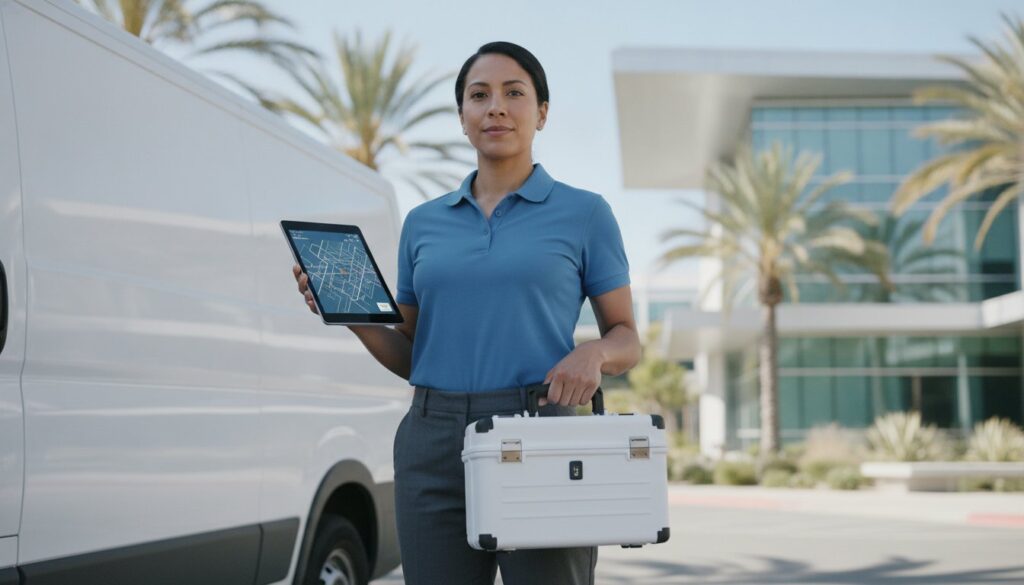
Securing a reliable HIPAA compliant courier service Los Angeles healthcare providers can trust is essential for safeguarding Protected Health Information (PHI) and maintaining regulatory compliance. Hospitals, clinical laboratories, outpatient surgery centers, and specialized medical clinics across Southern California handle sensitive patient files, diagnostic pathology specimens, and confidential records daily. Handing these items over to an unvetted delivery driver or an on-demand rideshare app exposes your organization to severe federal penalties, catastrophic data leaks, and compromised patient care. Navigating the complex logistics landscape of Los Angeles County requires an established courier service that combines rigorous physical security with an uncompromising adherence to federal privacy mandates.
Transporting medical materials throughout the greater Los Angeles metropolitan area presents logistical challenges unlike anywhere else. High-density traffic along major arteries like the 405, 101, and I-10 can turn a routine 15-mile specimen transfer into a multi-hour ordeal. Without temperature-controlled transport, tamper-evident security measures, and drivers trained in bloodborne pathogen management, biological samples spoil and confidential patient data faces exposure. True compliance demands more than a magnetic sign on a car door; it requires verifiable chain-of-custody protocols, real-time GPS fleet tracking, and legally binding compliance documentation.
HIPAA Compliant Courier Service Los Angeles: Understanding Regulatory Requirements
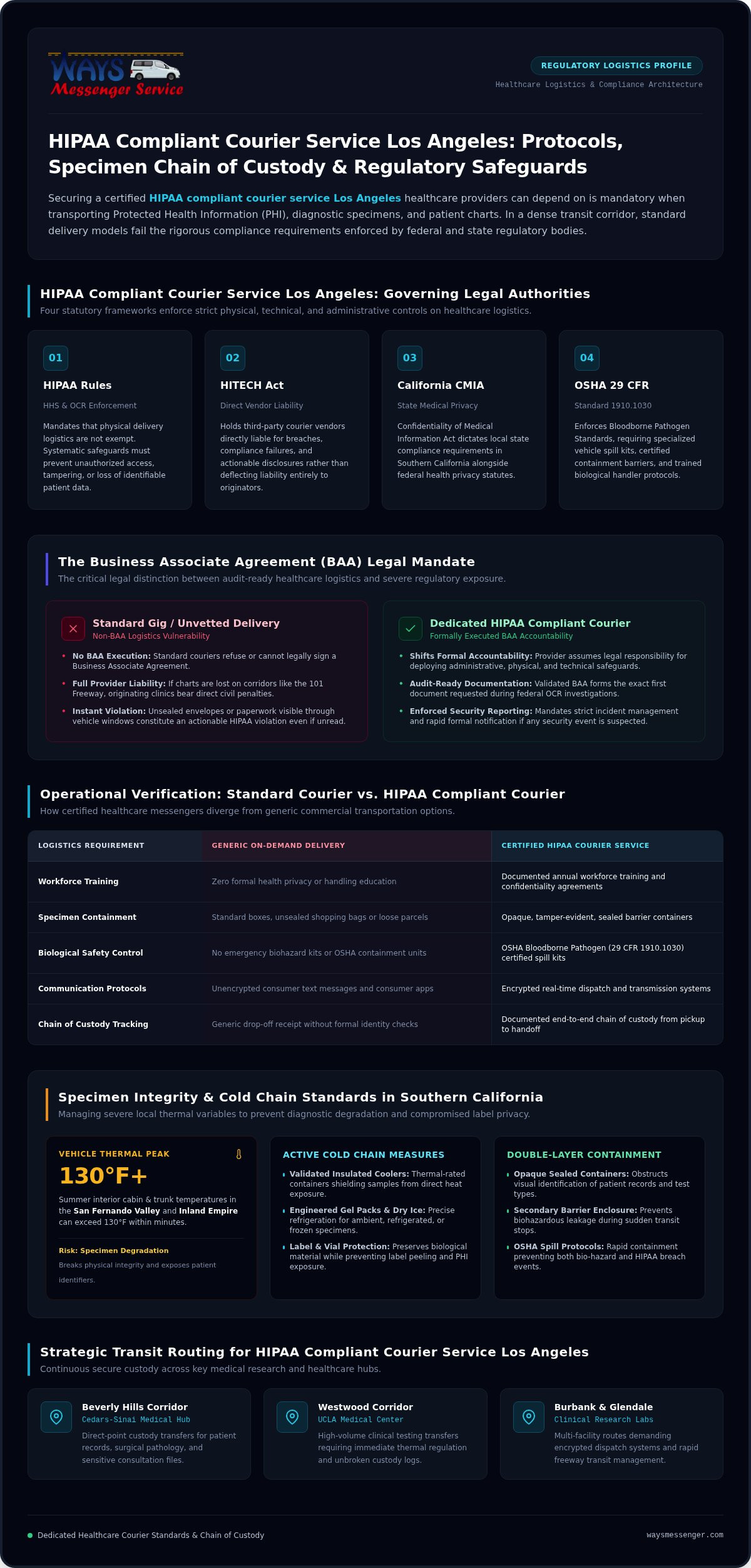
A certified HIPAA compliant courier service Los Angeles acts as a physical safeguard within the broader framework established by the Health Insurance Portability and Accountability Act of 1996 and the Health Information Technology for Economic and Clinical Health (HITECH) Act. Under federal law, physical transportation of medical records, radiology scans, laboratory specimens, prescription medications, and billing documentation falls under strict handling standards. The Department of Health and Human Services (HHS) and its Office for Civil Rights (OCR) actively audit healthcare networks and enforce multi-million-dollar fines against institutions that fail to secure PHI during transit.
PHI extends far beyond digital databases and electronic health records. In a physical delivery context, any package label bearing a patient name, date of birth, medical record number, diagnostic code, or clinical notes constitutes sensitive data. If an unauthorized third party reads a manifest, intercepts a paperwork pouch, or gains access to an unattended delivery vehicle, a reportable breach occurs. The HITECH Act holds logistics providers to the same federal liability standards as covered entities, eliminating the legal buffer between healthcare providers and their delivery vendors.
The Legal Necessity of the Business Associate Agreement (BAA)
The Business Associate Agreement (BAA) is the foundational legal document governing any relationship between a medical provider and a professional courier. Under federal regulations, any third party that handles, transports, or has potential physical access to PHI must sign a BAA prior to dispatching a single package. This agreement formally recognizes the courier as a Business Associate, binding the transportation company to federal privacy protocols, mandatory employee background checks, breach notification timelines, and civil penalty liabilities.
Working with an independent courier or standard delivery platform that refuses or fails to execute a formal BAA is an immediate regulatory violation for a covered entity. In the event of an audit or lost package, the healthcare practice bears direct legal and financial responsibility for outsourcing delivery to an unvetted vendor. A compliant medical courier service in Los Angeles executes comprehensive BAAs as a standard operating procedure, absorbing shared accountability and demonstrating operational integrity.
Specimen Integrity and Privacy Standards in Southern California
Specimen transport sits at the intersection of biological safety and information privacy. Every vial of blood, tissue biopsy, or urine culture carries an identifier that connects the physical biological matter directly to an individual patient. Protecting specimen integrity is directly tied to protecting patient privacy. Couriers operating in Los Angeles must maintain rigid chain-of-custody documentation from the exact second a specimen is retrieved at a clinic in Beverly Hills to its drop-off at a reference laboratory in Burbank.
Physical security standards require locked transport totes, spill-containment systems, and continuous climate monitoring. Ambient temperatures inside a delivery vehicle trapped in midday traffic on the Hollywood Freeway can easily exceed 100 degrees Fahrenheit without proper air-handling equipment. Extreme heat degrades enzymes, lyses blood cells, and renders diagnostic samples unusable, delaying diagnoses and requiring patients to undergo repeat invasive procedures. Professional medical couriers utilize certified coolers, phase-change materials, dry ice configurations, and digital temperature data loggers to guarantee sample viability throughout transit.
Key Features of a HIPAA Compliant Courier Service in Los Angeles
Selecting a reputable courier requires evaluating the operational capabilities, physical equipment, and training regimens that separate professional medical messengers from general parcel services. Because healthcare deadlines directly impact patient outcomes, your logistics partner must maintain a fleet equipped for immediate dispatch, urgent cold-chain support, and continuous electronic verification.
- Dedicated Driver Training: Couriers must undergo documented, annual training covering HIPAA privacy standards, HITECH regulations, OSHA bloodborne pathogens, and hazardous materials handling under DOT 49 CFR.
- Digital Chain of Custody: Continuous electronic verification, including barcode scanning at every transition point, real-time dispatch logging, and secure digital signature capture.
- Climate-Controlled Fleet: Vehicles equipped with verified air conditioning, specialized cold-storage units, ambient temperature monitoring, and biohazard containment systems.
- Unbroken 24/7 Operations: Continuous access to live, local dispatchers who understand regional traffic patterns and can reroute vehicles during unexpected highway closures.
- Physical Security Protocols: Vehicles equipped with locked cargo areas, tinted security glass, and strict protocols that forbid leaving unattended medical cargo unlocked or visible.
Advanced Tracking and Chain of Custody Protocols
Modern compliance hinges on real-time visibility. When moving sensitive pathology slides or confidential legal medical files between hospital campuses in Santa Monica and downtown Los Angeles, blind spots create vulnerability. Leading medical couriers deploy GPS-tracked fleets monitored through central dispatch consoles that record velocity, route anomalies, and arrival timestamps with pinpoint accuracy.
At every stage of the delivery, the chain of custody must remain unbroken. The process begins with an electronic barcode scan upon pickup, confirming package custody transfer from the facility staff to the driver. The driver’s transit route is tracked in real time, accounting for traffic diversions. Upon arrival, the recipient provides a digital signature and printed name, generating an automated, time-stamped proof-of-delivery report. This paperless, tamper-proof record provides ironclad documentation for both internal facility audits and federal compliance reviews.
Driver Certification and Professional Conduct
The delivery driver represents the final, critical link in healthcare compliance. A professional medical courier must undergo rigorous screening that includes multi-state criminal background checks, ten-panel drug screenings, and motor vehicle driving record audits. Beyond standard vetting, drivers require formal certifications verifying their knowledge of universal precautions, spill response protocols, and patient privacy boundaries.
Professional conduct inside clinical environments is equally paramount. Couriers must display clear corporate identification badges, wear clean uniforms, and carry personal protective equipment (PPE) to enter sterile laboratory spaces, intensive care wings, and surgical reception desks in facilities such as Cedars-Sinai or UCLA Medical Center. Drivers trained in medical logistics understand the sensitive nature of healthcare settings and handle patient documentation discreetly, avoiding unauthorized verbal or physical disclosure of medical details.
Vetting Your HIPAA Compliant Courier Service Los Angeles: A 10-Point Checklist
Healthcare administrators, laboratory operations managers, and clinic supervisors should use a structured framework when auditing prospective delivery vendors. Use this 10-point checklist to assess whether a service provider meets federal standards and local operational requirements:
- Executed Business Associate Agreement (BAA): Does the courier provide a comprehensive, legally vetted BAA that explicitly defines their duties and liabilities under HIPAA and HITECH?
- Certified Driver Training Records: Can the company provide documented proof of employee certification in OSHA bloodborne pathogens, universal precautions, and PHI handling?
- Documented Breach Notification Plan: Does the courier have a written, step-by-step incident response plan detailing how they detect, report, and mitigate potential data breaches or package losses within statutory deadlines?
- Continuous Temperature-Control Capabilities: Does the fleet feature verified equipment for ambient, refrigerated (2°C to 8°C), and frozen (-20°C or colder with dry ice) transport?
- Spill Kit Equipment & Biohazard Response: Is every vehicle equipped with an OSHA-compliant biohazard clean-up kit, extra PPE, and certified transport packaging to contain accidental fluid leaks?
- Live GPS Tracking and Route Optimization: Can dispatchers and clients monitor the courier’s location in real time to verify travel progress and identify delays immediately?
- Tamper-Evident Security Infrastructure: Does the vendor use serialized tamper-resistant zip-ties, numbered seals, and lockable vehicle containers to ensure packages cannot be accessed during transit?
- Electronic Proof of Delivery (e-POD): Does the system generate immediate, paperless receipt confirmations with time, date, GPS coordinates, and recipient signature upon delivery?
- Direct Employment vs. Gig Economy Contractors: Are couriers trained W-2 employees or vetted dedicated contractors held to documented performance and compliance standards, rather than casual crowd-sourced drivers?
- Local Fleet Density & 24/7 Availability: Does the service maintain sufficient regional coverage across Los Angeles County, Orange County, and Ventura County to handle unexpected rush pickups during non-standard hours?
Infrastructure and Security Vetting
Auditing a courier service requires looking closely at vehicle security and dispatch operations. When moving legal medical records, forensic evidence, or sensitive biopsy materials, couriers must not leave cargo visible through passenger windows. Medical couriers utilize partitioned cargo compartments, heavy-duty lockboxes bolted to the vehicle frame, and secondary security latches to prevent theft during routine fuel stops or multiple-stop routes.
Dispatch communication must also adhere to strict digital privacy guidelines. Dispatch systems handling patient names, destination clinic rooms, or sensitive diagnostic requirements must utilize end-to-end encryption. Mobile communication between drivers and dispatchers must run through dedicated, password-protected handheld devices rather than consumer-grade SMS messaging apps. Secure data transmission ensures unencrypted patient information never leaks over open cellular networks.
Insurance and Liability Considerations
Standard personal auto insurance policies exclude commercial delivery activities, and standard commercial courier insurance often excludes the loss of biological materials or regulatory fines arising from data breaches. Healthcare facilities must verify that their delivery partner holds comprehensive commercial liability, cargo insurance, and dedicated errors and omissions (E&O) coverage tailored for medical and legal logistics.
If an irreplaceable biopsy or an urgent chain-of-custody specimen is lost or compromised in transit, the financial and clinical consequences are catastrophic. A qualified courier carries policy limits sufficient to cover clinical rework, patient compensation, and regulatory legal defense. When coordinating high-stakes transfers, partnering with an established provider like lab specimen courier solutions in Los Angeles ensures that comprehensive insurance limits and established contingency procedures protect your practice against operational disruptions.
Choosing Ways Messenger for HIPAA Compliant Courier Service Los Angeles
Ways Messenger provides mission-critical medical delivery and same-day messenger services across the Southern California basin. We serve as the dedicated logistics backbone for regional hospital networks, outpatient surgical groups, independent diagnostic laboratories, research centers, and law firms. When time-critical diagnostics, organ tissue, or sensitive case files must move securely, our team delivers unwavering precision, compliance, and speed.
We eliminate the risks associated with generalized delivery apps and unfocused parcel carriers. Our entire workflow—from call intake and computerized dispatch to final handoff—is engineered around strict chain of custody, professional privacy, and relentless urgency. Whether you require a scheduled daily route connecting multi-site medical clinics or an on-demand STAT dispatch during peak traffic, Ways Messenger protects your reputation and secures your deliveries.
Expert Navigation of Los Angeles County and Beyond
Southern California’s urban layout presents severe logistical hurdles. A freeway gridlock on the Sepulveda Pass or unexpected construction on the Long Beach Freeway can compromise time-sensitive samples without expert local knowledge. Ways Messenger dispatchers and couriers have spent years mastering the intricate street systems, commercial alleys, parking structures, and loading docks of every major medical district in the region.
Our service area extends across all of Los Angeles County—including Beverly Hills, Burbank, Glendale, Pasadena, Culver City, and Santa Monica—as well as Orange County, Ventura County, Riverside County, and Santa Barbara. We understand the specific drop-off bays, security checkpoints, and restricted delivery suites of facilities from Downtown Los Angeles to regional research hubs. This local operational mastery guarantees that our drivers bypass unnecessary bottlenecks and deliver sensitive cargo directly into the hands of authorized personnel.
Get Started with Secure Medical Delivery Today
Establishing compliant medical transport should be straightforward and dependable. Ways Messenger pairs rapid operational onboarding with comprehensive compliance documentation, providing signed Business Associate Agreements, insurance certificates, and clear rate structures tailored to your route frequency. From scheduled daily lab specimen sweeps to emergency 24/7/365 rush assignments, our team is equipped to safeguard your medical cargo.
For operations requiring round-the-clock responsiveness, our 24-hour courier service in Los Angeles guarantees that late-night blood runs, emergency surgical device deliveries, and weekend specimen pickups receive the same level of care as daytime deliveries. If your practice also manages litigation files, malpractice defenses, or confidential subpoenas, our specialized team provides certified court document filing courier services that maintain the exact same chain-of-custody rigor.
Frequently Asked Questions About HIPAA Compliant Courier Service Los Angeles
What makes a courier service HIPAA compliant in Los Angeles?
A courier service achieves true HIPAA compliance through a comprehensive combination of legal agreements, specialized driver training, physical vehicle security, and verifiable electronic chain-of-custody protocols. The provider must sign a formal Business Associate Agreement (BAA) with the medical facility, legally committing to protect Protected Health Information (PHI). Drivers must be trained and certified in HIPAA privacy laws, OSHA bloodborne pathogen containment, and patient confidentiality standards. Furthermore, vehicles must feature climate-controlled compartments, locked security containers to prevent unauthorized physical access, and encrypted digital tracking tools that record pickup, transit, and drop-off milestones with tamper-proof electronic signatures.
Do I really need a BAA with my Los Angeles messenger service?
Yes, executing a Business Associate Agreement is a mandatory federal requirement under both HIPAA and HITECH Act regulations whenever a third-party courier handles packages containing PHI. Even if delivery drivers do not open the packages, their physical possession of containers bearing patient names, case numbers, medical charts, or diagnostic specimens classifies them as Business Associates. Using a delivery service without an executed BAA is an immediate compliance violation that exposes the healthcare provider to direct federal civil monetary penalties from the Office for Civil Rights (OCR), regardless of whether an actual physical data leak occurred.
How does Ways Messenger handle urgent lab specimen transport in LA traffic?
Ways Messenger overcomes regional gridlock through a coordinated combination of live GPS fleet tracking, regional dispatch routing, and localized street-level navigation experience. Our dispatchers monitor traffic data across major arteries—such as the 405, 101, I-5, and I-10 corridors—and proactively route drivers onto optimized surface streets to bypass severe highway slowdowns. For temperature-sensitive specimens, our couriers utilize certified cold-chain packaging, specialized coolers, dry ice protocols, and active temperature monitoring systems to ensure that biological materials remain within required temperature ranges throughout the entire journey.
Can a HIPAA compliant courier also handle confidential legal document delivery?
Yes, the strict chain-of-custody and data privacy measures required for medical deliveries translate directly to high-stakes legal document transport. Ways Messenger regularly handles confidential litigation filings, medical malpractice records, sensitive trial exhibits, and courthouse filings for law firms throughout Southern California. The same locked cargo areas, time-stamped digital signature verification, and secure point-to-point routing that protect patient medical records ensure that sensitive legal papers arrive safely, confidentially, and on schedule without risk of unauthorized disclosure.
What happens if a medical delivery is delayed or compromised during transit?
A compliant courier service maintains structured contingency plans to handle unexpected mechanical breakdowns, severe traffic halts, or physical package incidents. If a transport vehicle encounters an issue, our dispatch system immediately identifies the delay and dispatches a nearby backup courier to execute an emergency custody transfer in accordance with protocol. If a package seal is damaged or an accident occurs, the courier executes an established incident reporting protocol, notifying the sending facility immediately with time-stamped documentation so staff can take appropriate clinical or compliance mitigation steps without delay.
Does Ways Messenger serve hospitals and labs in Orange County and Ventura County?
Yes, while headquartered in Los Angeles, Ways Messenger provides broad delivery coverage across the entire Southern California region. Our daily courier routes and on-demand STAT services extend throughout Los Angeles County, Orange County, Ventura County, Riverside County, and Santa Barbara. We regularly transport surgical kits, routine lab specimens, and time-critical medical supplies between regional healthcare networks, medical research facilities, and community health centers across multiple county borders around the clock.
When patient well-being and legal compliance are on the line, partner with a dedicated logistics team that understands the vital responsibilities of medical delivery. Contact Ways Messenger today to establish your secure delivery routes and maintain total chain-of-custody compliance throughout Southern California.